Process Automation for Transport and Logistics
June 1, 2026
Business Tips
Business Tips
Transport & Logistics
NIS2
Transport, shipping and logistics operations run continuously. Orders, invoices, customs records, CMR consignment notes, subcontractor agreements and claim reports move between drivers, dispatchers, warehouses and customers. Manual handling and email attachments make every missing document, delayed approval and incorrect record an operational cost.
NIS2 adds a regulatory requirement to manage cybersecurity risk and document critical processes. Transport is listed among the directive's sectors of high criticality, making traceable procedures and reliable records an immediate business priority.
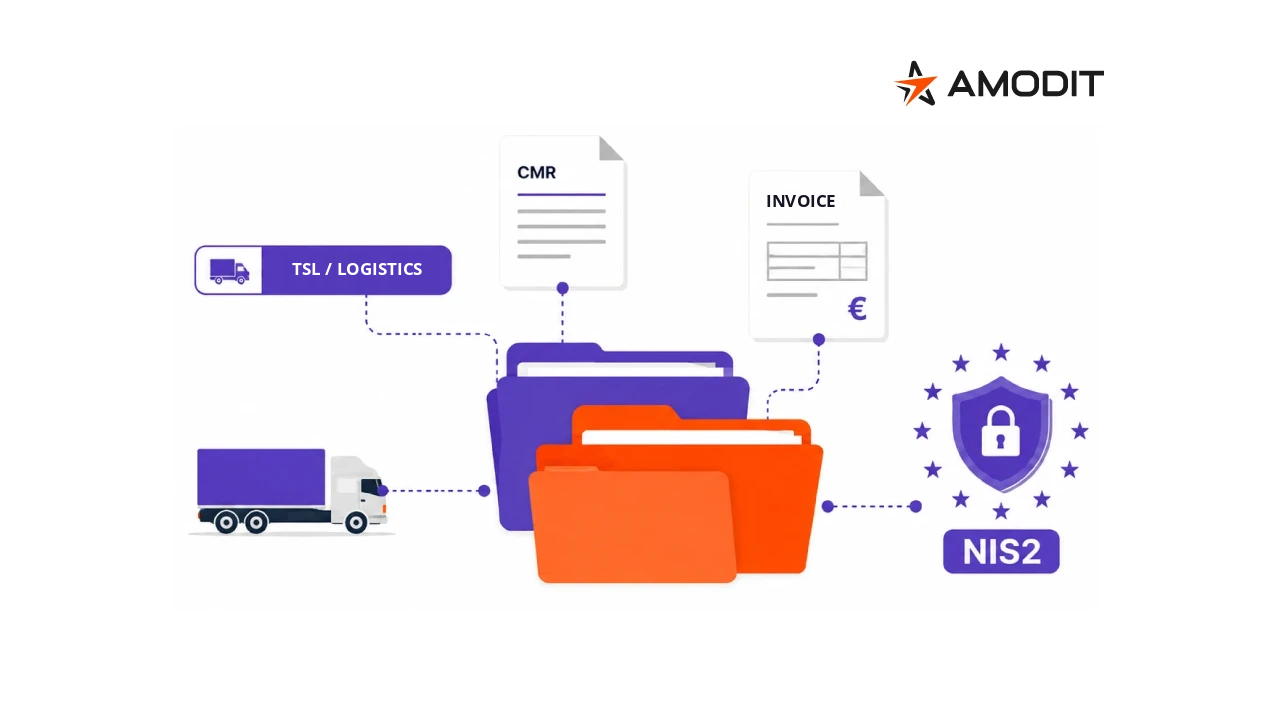
Where Transport Documentation Breaks Down
Document disorder has direct operational consequences in transport and logistics. A missing CMR consignment note can block settlement. An unverified subcontractor invoice can become a dispute. A carrier agreement signed a week after the work creates legal risk.
Transport and logistics companies coordinate many subcontractors, customers and locations. Records originate in offices, terminals, warehouses and vehicles. Without a central document workflow, departments work from different versions of the facts and spend hours establishing the current status. Customs records require accurate dates and references, claim reports have response deadlines, and framework agreements often require regular amendments. Manual handling creates errors and delays in each of these processes.
What NIS2 Means for Transport and Logistics
Transport is listed in NIS2 as a sector of high criticality. The directive creates several obligations directly related to documentation and process management:
Risk Management and Evidence
Organizations must implement operational and cybersecurity risk-management procedures and be able to demonstrate that those procedures work during an audit.
Incident Recording and Reporting
Serious incidents, including operational disruption caused by a cyberattack or system failure, require an early warning to the competent authority within 24 hours. A defined incident workflow assigns roles, sends notifications and records the response.
Supply Chain Security
NIS2 requires organizations to assess suppliers and subcontractors and include appropriate security clauses in agreements. Managing subcontractor contracts through an electronic document workflow provides version history and a documented approval path.
A Complete Audit Trail
Supervisory authorities can request documentation. Organizations must be able to show who made a decision, when it happened and what action was taken. An electronic workflow records each operation.
How Process Automation Supports These Requirements
Business process automation changes how transport and logistics organizations manage operational and regulatory risk:
- A centralized document workflow provides one controlled version of agreements, orders and reports. Each record follows a defined verification, approval and archiving path.
- Invoice workflow automation supports KSeF (Poland's National e-Invoicing System) and handles subcontractor invoices without rekeying data. AMODIT uses configured AI models to extract document data and route it according to approved rules; authorized employees review exceptions and approve decisions.
- An incident-handling workflow defines responsibilities and deadlines before an operational problem occurs. Notifications, due-date controls and an action history support incident reporting.
- Subcontractor contract management maintains the current agreement, change history and complete approval path in one place.
- Integration with TMS, WMS and ERP platforms exchanges data between core systems without repeated manual entry or comparison.
Document Workflow in Logistics
NIS2 requires transport and logistics companies to address their own controls and assess technology suppliers. AMODIT supports both levels. As an ICT provider, it holds ISO certifications and has completed independent security testing. Its document workflows maintain supplier-agreement versions, approvals and security clauses, giving teams evidence for a NIS2 audit.
AMODIT is an AI-supported low-code platform. Teams configure processes without programming and update them as operations or requirements change. Rhenus Warehousing Solutions Poland is one transport and logistics customer using the platform.
Controlled Documentation and Audit Readiness
Process automation strengthens two areas at the same time:
- operations, through faster and more accurate handling with fewer errors;
- regulatory readiness, through documented procedures and complete audit trails.
Every hour and document matters in transport and logistics. Controlled workflows reduce operational risk and provide the evidence required for compliance.
1Does NIS2 apply to every transport and logistics company?
NIS2 mainly covers medium and large transport and logistics organizations. Transport is listed as a sector of high criticality. Smaller companies in the supply chains of covered organizations can also face requirements through partner contracts.
2Where should transport and logistics process automation start?
Start with the area that creates the greatest delay or risk. Common starting points are purchase invoice workflows and subcontractor contract management. As a low-code platform, AMODIT supports launching the first process within weeks without a custom development project.
3Can a document workflow support NIS2 requirements?
Yes. AMODIT provides an audit trail, operation logs, access controls and defined incident-response workflows. These capabilities support the documentation and risk-management controls required by NIS2.
4Does AMODIT integrate with TMS and ERP platforms used in logistics?
Yes. AMODIT integrates with TMS, WMS and ERP platforms and exchanges data with other systems through its REST API.
Documents and information from different sources can move through one controlled environment. The platform supports processes that require reliable exchange between systems, departments and decision owners.
Only authorized users can access the data, and every operation is recorded. The organization can track who accessed specific information, when it happened and at which process stage.