

Preparing for AI Agents
December 23, 2025
Business Tips
AI Agents
Workflow
For years, AI was often described as a statistical parrot: it generated text from probabilities without understanding what sat beneath the words.
Developments in 2025 challenged that simple assumption. Models now move beyond fluent answers to tasks that require analysis, planning and interpretation of context. That capability does not transfer accountability: people review AI outputs and approve process decisions.
When the “Parrot” Began to Reason
Andrzej Dragan’s book Quo V-AI-dis highlights a central tension: researchers understand the algorithms used to train neural networks, yet still do not fully understand how those networks later reason.
Models now interpret people and the world in ways that go beyond simple statistical recall. Evidence from science and business in 2025 points to systems entering areas once associated with human intellectual work: reasoning, planning and discovery.
Evidence From Drug Discovery
The Polish source cites three developments from the preceding 12 months. In June 2025, Rentosertib—a pulmonary fibrosis drug for which AI identified the biological target and designed the molecule—completed a successful phase-two clinical trial. In October, another model designed a targeted antibiotic against E. coli. In December, the FDA accepted an AI-generated analysis as scientific evidence.
These examples illustrate the broader shift from fast, intuitive “System 1” answers toward slower, more deliberate “System 2” reasoning.
Polish researchers and engineers have contributed to that shift, including Wojciech Zaremba of OpenAI, Łukasz Kaiser—one of the authors of the Transformer architecture—and Andrzej Dragan. Their framing moves the model from an encyclopedia toward a researcher.
From Chatbots to Agents
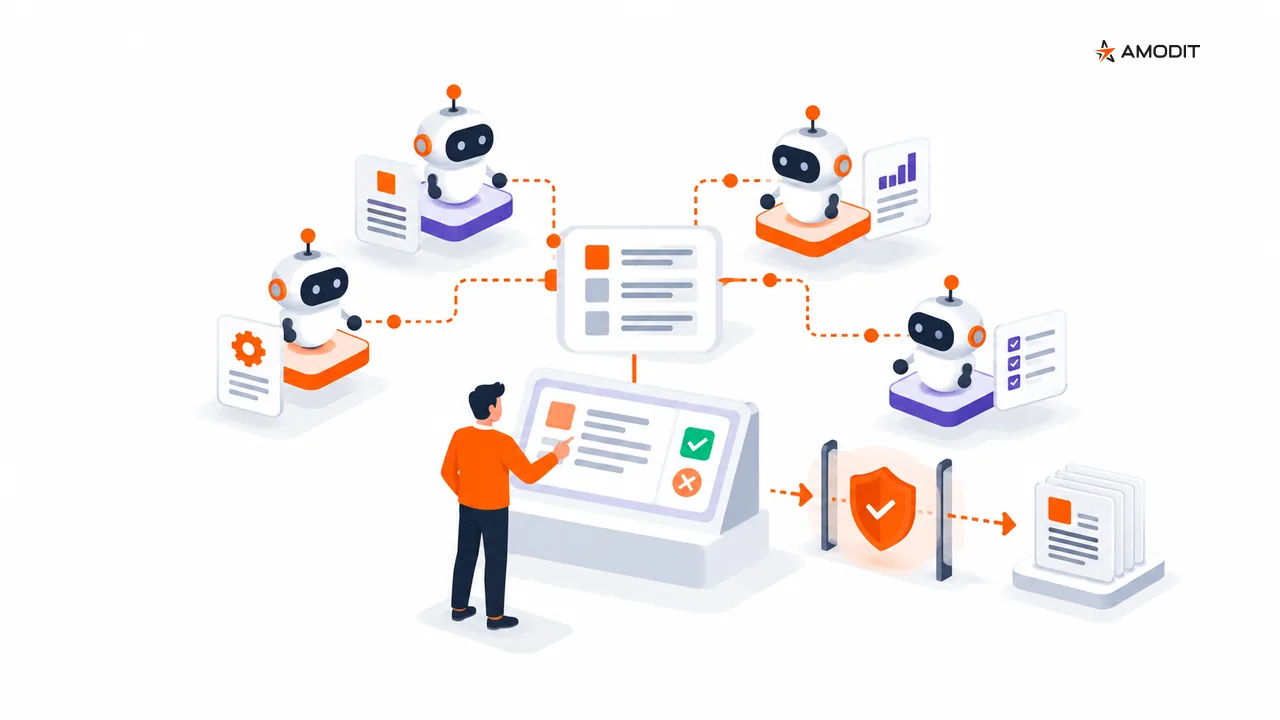
A chatbot answers “How do I make a backup?” In a configured workflow, an AI agent can check available resources, create the backup, verify it and prepare a report. A person reviews the result and approves the next step.
The difference is configured work within a process. A chatbot explains a task; an agent performs bounded steps and returns the result for human review. Technology is moving from systems that only explain tasks toward agents that execute defined steps through APIs. The source cites a16z’s Big Ideas 2026 as a signal that infrastructure will increasingly be designed for agents rather than only for people clicking graphical interfaces.
Business use requires a clear trigger, instruction, context, expected result, subsequent process path and constraints. AI performs the configured task and prepares the result; a person reviews that output and approves the subsequent process decision.
How an AMODIT Agent Rule Structures the Work
In AMODIT, an AI agent handles a process task that requires interpretation of content and context. The administrator defines:
- when the rule runs;
- the instruction for AI;
- the input and context available for the task;
- the expected result;
- the subsequent process path;
- safeguards and limitations.
This configures an existing AI model; it does not train a new one. The rule provides a repeatable way to submit the task to AI, while a person verifies the result and approves how it is used in the workflow.
For the practical configuration scope, read How to Configure an Agent Rule in AMODIT.
Practical Implications
If models can reason over complex scientific information, they can also support business work such as:
- analyzing documents in a broad context;
- checking business data for inconsistencies;
- drafting and optimizing process designs.
Understanding Instead of Extraction
An agent can analyze a document as a whole, including agreements, acceptance protocols and business dependencies. Multimodal models can interpret layout and context rather than extracting isolated fragments only. A person verifies the interpretation before it drives a decision.
Actions Instead of Clicks
Configured agents perform defined steps and exchange data with other tools. Their trigger, instruction, context, result, subsequent process path and constraints set the boundary of the task. The AI output follows that configured path; a person reviews it and approves the next step.
Creation Instead of Manual Configuration
Natural-language descriptions can produce draft process diagrams, forms and business logic. This lowers the barrier to process design, while process owners review, test and approve each result.
Prevention Instead of Firefighting
Agents can monitor system health, combine signals and identify emerging issues before they become outages. That supports a move from reactive maintenance toward proactive diagnostics, with operators reviewing the signals and approving corrective action.
AI as Part of a Controlled Workflow
In 2026, AI is moving from an experiment toward performing real work inside configured processes. Organizations can use that opportunity when workflows define what the agent does, what result it returns and where a person reviews and approves the next decision.
The central readiness question is no longer whether AI can generate a plausible answer. It is whether the organization has prepared its data, processes, instructions, context, constraints and human approval points for AI-assisted work.
Explore AI-Driven Workflow
Article by:

Janusz Bossak
AMODIT Development Director
Janusz combines technical knowledge with business experience in process optimization, performance improvement and work-cost reduction. He guides the development of the AMODIT platform. Photography is his passion.